Shopify is now using AI to move you onto Polaris Web Components
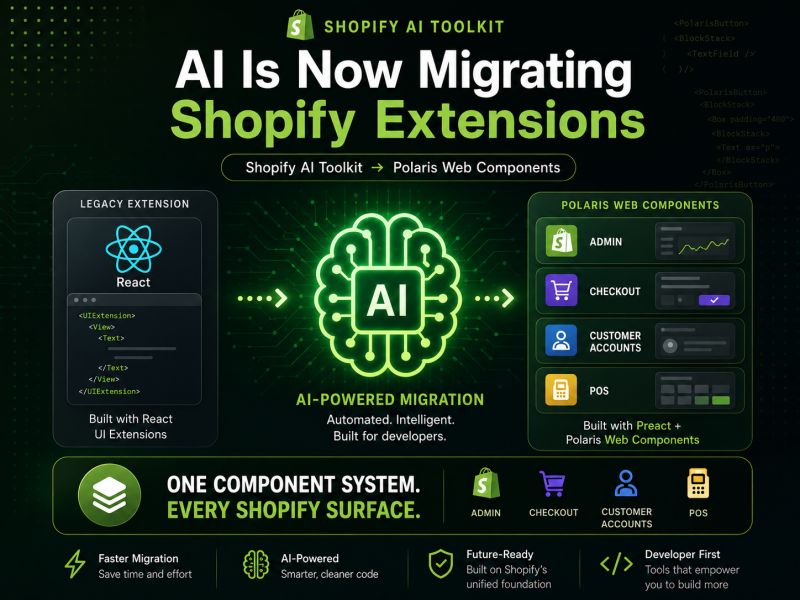
Shopify just made one of its biggest platform migrations a lot easier. They released an AI Toolkit that upgrades extensions to Polaris Web Components.
Read as a tool, that is a convenience. Read as a signal, it is louder than that. Shopify is not just telling you where the platform is going, it is now paying to carry you there. (This started as a LinkedIn post.)
The pattern this fits
For years Shopify has been steadily moving developers toward platform-native architecture, one deprecation at a time:
- Scripts became Functions
- checkout.liquid became Checkout Extensibility
- Hosted app experiences became UI Extensions
- React-based extensions are becoming Polaris Web Components
Every step traded custom code you owned for a framework Shopify owns. The direction has been consistent. What is new is the acceleration: this time the migration comes with AI doing the manual work.
What actually matters here
Faster migration with less hand-editing is the obvious win, but not the interesting one. These are:
One component system across every surface. Admin, Checkout, Customer Accounts, and POS stop being four dialects of the same idea. Build once, render anywhere Shopify renders.
Performance and consistency by default. When the components are Shopify’s, their rendering budget is Shopify’s problem, not something you re-solve in every extension.
A very clear statement of intent. Shopify does not build migration tooling for a direction it is ambivalent about.
The takeaway
Polaris Web Components are no longer something to watch. They are something Shopify is actively helping you adopt, which is the stage right before they become something Shopify expects you to have adopted.
If you ship Shopify apps, the toolkit is worth an afternoon now. The migration is not optional, it is just currently cheap.